Stereo weirdness using one channel on 2-way speaker
Hi all,
I'm climbing the sigmastudio learning curve, running into conceptual/vocabulary issues trying to use search.
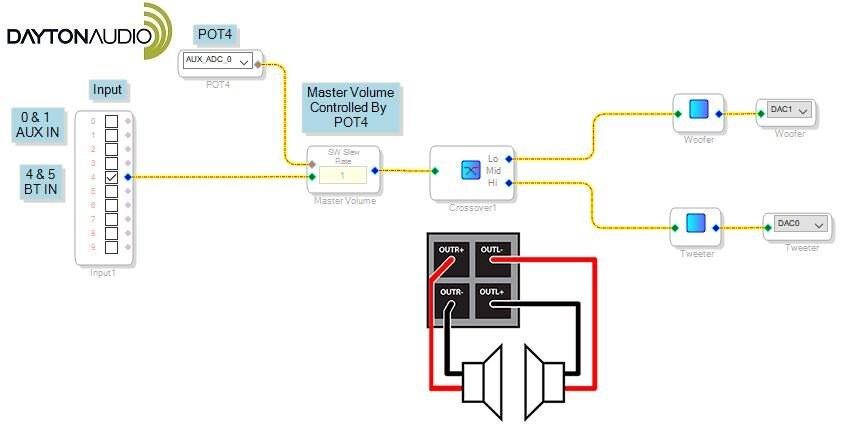
Goal: 2-way portable bluetooth speaker. No line in. 2x30w Dayton KABD board with channels split between high/low crossover (rather than left/right). Parametric EQ and gain applied to each speaker based on REW measurements.
Assumption 1: I've read that using the stereo to mono block can lose detail at the high end, which is why I unchecked one of bluetooth in channels instead (#5 on input 'panel'). I've always used amps with passive crossovers, wired to a single channel, so that seemed normal.
Assumption 2: DAC0 and DAC1 equate to OUTR and OUTL in the wiring diagram in the image. Crossover set to LR 24db at 500hz.
Assumption 3: This is actually a 3-way speaker. The mid and tweeter have a passive crossover. For the purposes of Sigmastudio, I'm assuming it's correct (won't cause problems) to treat them as a 'tweeter' since they run off a single +/-. Reason for this is I didn't want to spend the $ on a 4x DSP given my stockpile of passive crossover parts.
Problem 1: If I shift the left/right balance of the connected bluetooth device, it will shift the signal to one speaker or the other. Expected is all output would be attenuated (or not) due to the input being just one channel.
Problem 2: The crossover may not be working. If I play a 100hz tone in REW, then shift output from Left to Right, the tweeter plays the signal at noticeable volume (it's a full range driver so capable). Expected is that essentially no 100hz signal would reach the high side two octaves down with a 4th order high pass at 500hz.
Thanks for any help sorting out this basic stuff!
Bonus questions if anyone feeling extra helpful:
Is it best practice to use power on/off via the board, like with a button or switch, or is a physical switch that cuts power to the board ok? Since the speaker runs off battery, even small draws add up between uses.
The wire kit came with 4 pots. The first one would not reduce volume to zero when all the way to the left (assuming defective). The 2nd does, but is similarly sensitive to the first (small turn = big volume change). Is there a way to reduce this sensitivity so the pot has more useful range?
Is there a way to ignore the volume setting of the bluetooth source? It would be a more consistent experience, especially for less tech savvy users who may not recognize the volume on their phone is all the way down.
What else is low-hanging fruit that's a cool use of this technology? I intend to play with the dynamic bass. Timing functionality doesn't seem to make sense to me given a mobile mono device with no set listening position and such a low xover for the woofer.
Appreciate any thoughts, thanks for your time!
-Ethan
Audio Signal Processors
Audio Products
software
4.7
mono
sigmastudio
SigmaDSP Audio Processors
adau1701
Show More
Hi Ethan,
Your expectation is exactly right -- the L-R balance should affect the volume of both speakers. Thus, the symptoms you're experiencing suggest that a default stereo program is running instead of the one you've designed. Dayton Audio's SigmaStudio Programming Guide pages 1 - 11 describes the necessary procedures to connect your programmer and load a compiled project. Apologies if you've already checked these, yet it does appear that something is preventing your new program from loading:
Page 5 -- Set the programmer's switch(es).
Page 6 -- Does SigmaStudio recognize your programmer?
Page 7,8 -- Link-Compile-Download --- check for the result "active downloaded" vs. "comms failure."
Page 11 -- To have your program run on its own, you need to write it to the E2Prom.
If you haven't already, try loading one of Dayton Audio's example projects to test whether it loads correctly.
The volume pot sensitivity at its low end is what happens when the Aux ADC output is connected directly to the Volume Control input. This causes a linear relationship between the pot position and the volume -- the black line in the graph below. Though it looks good, our ears don't work this way. The red audio taper curve feels more natural. Old radios and such had pots designed for this, but in DSP we can use any of several methods to provide this curve. One way is to use a Linear Interpolator. A very simple way is to connect the Aux ADC to both inputs of a multiply block, whose output feeds the Volume Control (that is, squaring the Aux ADC output).
You'll find the Dynamic Bass block useful for getting the most from your woofer. Also, some time ago I came up with a project which compensates for the treble loss caused by mixing down to mono.
Best regards,
Bob

Thanks for your time replying, Bob!
I only had time this morning to confirm the connection steps. I had been doing the 'connect' button instead of 'download'. Using download has resolved the stereo problem! I was getting a false positive that it was configuring the DSP using 'connect' because when I'd change the output options (DAC0, DAC1) to something else on the list, it would disable that speaker. I confirmed that L/R adjustment attenuated both speakers correctly, and that the crossover was working as I upped the tone generator in REW.
This was based on one of the Dayton templates (Mono 2-way speaker) that I deleted most of the parts from, so you were correct that it would be set up properly.
That makes sense, I believe, on the audio volume. I'm assuming the value goes from 0-1, which is why squaring it would give you the graph you drew. I believe based on your description I can find other posts that discuss setting this up. It lets me know that it doesn't involve a mapping table, which is one of the things that kept coming up via google.
Thanks for linking your code to retain the highs going from stereo to mono! It clearly has complexity + concepts I've yet to touch. Do you think your example is useful to me at this stage as a learning exercise, or is it doomed to the same kind of failure someone would have skipping 101 and going straight into organic chemistry?
Outstanding questions post-Bob:
Power on/off best practice
Possibility of ignoring bluetooth source device volume
Please log in to reply.