0dbfs input vs headroom used with LIMITER that allows +24db Threshol
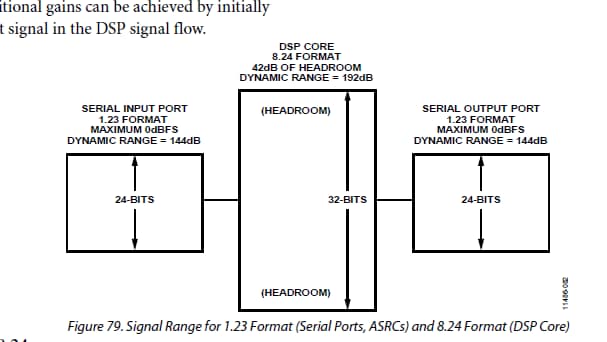
Understanding that 0dbfs is full scale input from ADC or output to DAC, but that is based on the 24 bit audio signal. I know there is headroom within the DSP to allow for 42db of headroom according to the data sheet.
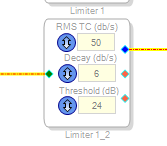
The Limiter block allows dB Threshold from -24dB to +24dB.
If I have signals above 0dB (internally in the DSP) due to gain or EQ, with the limiter set to 0dB or 6dB or 12dB (for example) , how does that get translated into the output where only 0dbfs is allowed.
"The four multipliers are 64-bit double precision, capable of multi-plying an 8.56 format number by an 8.24 number. The multiply accumulators consist of 16 registers, with a depth of 80 bits. The core can access RAM with a load/store width of 256 bits (eight 32-bit words per frame). The two arithmetic/logic units (ALUs) have an 80-bit width and operate on numbers in 24.56 format. The 24.56-bit format provides more than 42 dB of headroom."
Audio Signal Processors
adau1452
hardware
sigmastudio
SigmaDSP Audio Processors
SigmaDSP
Show More
Hello,
Your understanding is correct. The 0 dB level defines signal excursions from -1.0 decimal to (1.0 - one LSB) decimal, which is all that's allowed at the input and output ports. Hard clipping occurs above this level, so typical equipment might show a "0 dB" level while the DSP output is about 12 dB below FS, to avoid clipping on peaks. Limiter settings near or above 0 dB wouldn't normally be used without gain before and attenuation afterwards.
Internal headroom allows for calculations inside high-Q filters whose coefficients often exceed 1.0 decimal. I've also used the headroom in sidechains and in non-audio applications.
Best regards,
Bob
Please log in to reply.