Designing ANC using NLMS Block
adativeattempt2.dspproj
Hi there,
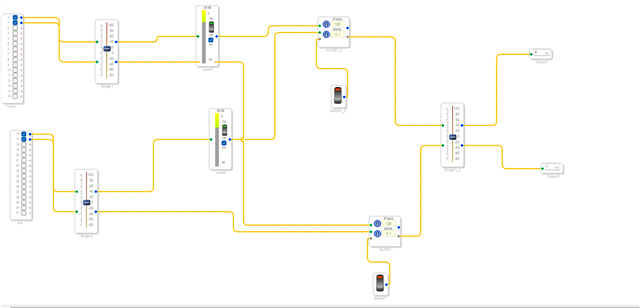
I’m working on designing an ANC algorithm using the NLMS block in SigmaStudio. However, when I listen to the result, the algorithm doesn’t seem to adapt.
For testing, I’m using synthetic files that are time-aligned and matched in level. I’ve also tested the same files with an NLMS algorithm I implemented in MATLAB, and it works fine there. The test files are about 2 minutes long, so I believe that should be enough time for the algorithm to converge. This makes me think the issue is with my SigmaStudio design.
I’m fairly new to this device and still getting used to the software. I’ve attached my schematic file. For hardware, I’m using the two input jacks: one for the mic signal and one for the noise file, and then outputting to Out 1 and 2 for stereo playback.
Could anyone help me understand why the NLMS block doesn’t seem to be adapting?
Thanks for your help,
aidantc9
Audio Signal Processors
adau1452
anc
software
Version 4.7 Build 0 Rev1831
nlms
sigmastudio
SigmaDSP Audio Processors
Show More
Hello aidantic9,
So you have one microphone? Also you have two speakers as you say for stereo output.
Can you provide details and or a picture of the location of the mic and speakers?
Thanks for supplying your project.
I assume you are trying this out on your desk? Is it a really reflective acoustic environment?
Dave T
Hi Dave,
Thank you for the fast reply,
In my setup I’m not using a physical microphone or speakers. I’m testing using two audio files, one as the mic input and the other as the noise input, they are being played from external devices. Does the NLMS block still adapt properly in this kind of purely digital test, or is it expecting the real acoustic path between speaker and mic? I would assume this would not matter but I am not sure.
Hello,
Your schematic is too generic, just I/O connected to the NLMS, so it's impossible to determine why it's not adapting without knowing something about the inputs. Typical one input represents the primary (noise) path connected to the NLMS desired input, and the other input represents the secondary (anti-noise) path connected to the NLMS filter input. In that case if the primary path is shorter than the secondary path you have a causality problem and the NLMS filter would have to go 'back in time' which means it can't adapt/converge
Hi Christopher,
Thank you for your reply. Regarding my inputs: one is a noise file, and the other is a mic file. The mic file is a synthetic file consisting of speech over the noise file. The files are aligned so there is no delay between them.
I tried adding a delay block to the noise signal and varied the delay, but this didn’t seem to help the algorithm converge. I’m not sure what I might be doing wrong here, so I was wondering if you have any suggestions or perhaps an example use case of the NLMS block that I could reference.
Thanks,
aidantc9
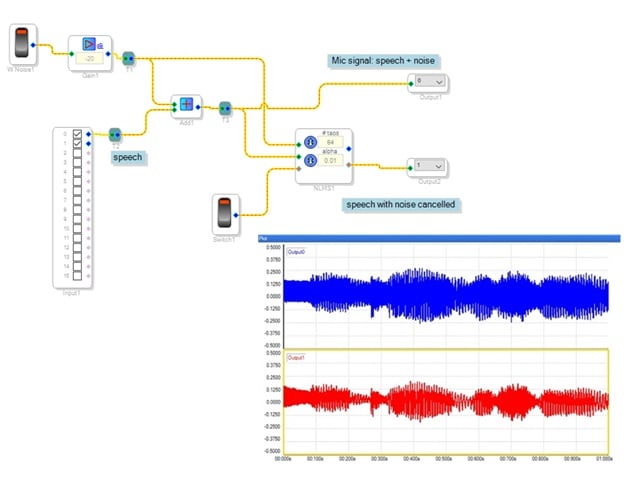
Here is an example that uses NLMS to cancel the noise:
Hi Christopher,
Thanks for sharing. I was able to produce similar results using simulated white noise and speech. I’m still struggling with my specific situation, but it may be due to the complexity of the noise I’m working with.
I plan to try a different implementation, but I suspect the issue stems from the rigid structure of the NLMS algorithm block. I may need to use a DSP that can be programmed directly rather than one that relies on prebuilt blocks. Unless you know of a way to vary more of the parameters of the algorithm like the normalization factor.
Thanks
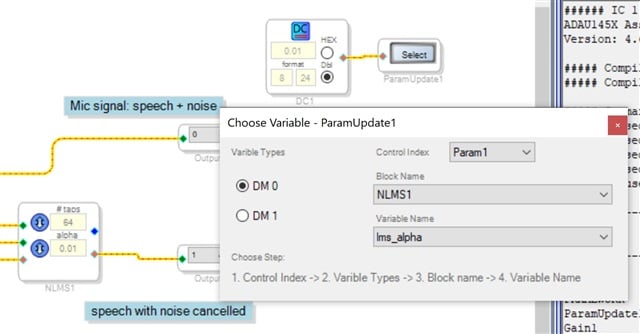
You can control normalization factor by controlling alpha, using the parameter update:
you can also control the time constant of the input energy detector
Thank you,
This helps a lot,
Aidan
Please log in to reply.