can ADAU1701 SDATA inputs be pulled low?
Hi,
I am working on an application where the ADAU1701 is receiving serial audio data on Multifunction Pin 1 that has been configured as serial audio data input.
It seems that this pin is always pulled up. The same stands for all other multifunction pins when set as SDATA inputs.
I was wondering if those can be pulled low.
On another application using an ADAU1761 I can choose to pull-up/down the SDATA lines. But it does not seem possible with an ADAU1701. Is that correct or I just need to write the right register in order to do that?
cheers,
Dimitris
Audio Signal Processors
SigmaDSP Audio Processors
adau1761
adau1701
Hello Dimitris,
Unfortunately, you do not have control of the pull up resistor in the 1701. There is an internal 15kohm pull up on all MP pins. So to pull this down to a valid low ~.8V would require a rather low value of pull-down resistor so I say the answer is no. For some reason the designers chose this low value of pull up rather than something like 100K.
The 1701 is an older part, the ADAU1761 came after and so we learned and put in more features like the configurable pull-up/pull-down resistors.
Generally, this is not a big problem with the sdata floating high. If for some reason you read this value it will be all "F's" and so that will be a -1 in 2's compliment. This number is almost zero and usually well into the noise floor or less than the DC offset of an ADC.
What is the problem you are running into?
Dave T
Hi Dave,
thanks a lot for the reply.
I am facing an issue where a Bluetooth module is sending SDATA to one of the digital inputs of the ADAU1701.
When a short audio cue is transmitted from the BT to the 1701, the SDATA line starts from high, transmits the data, stays low for short period of time after the data transmission and then jumps back to the default high state.
This jumping back to hi creates a pop noise in the digital input of the 1701, transmitted down to the amplifier.
It does not happen all the time, maybe 1 out of 5 or 10 trials, but it does happen.
I have verified that this jump is causing this pop noise in the input.
This does not happen with the ADAU1761 as the default SDATA line state is low.
the BT module default level on the SDATA line is also low.
I am looking into a way of solving this and my first thoughts were to switch the default state of the SDATA line on the 1701 side. But it is not possible.
Do you have any ideas that could set me to the right path on tackling this?
cheers,
Dimitris
Hello Dimitris,
So it looks like the Bluetooth module must go into a high-impedance mode once it is done transmitting. But do the LRCLK and BCLK continue being sent?
We have two ways we can try to tackle this.
Method 1:
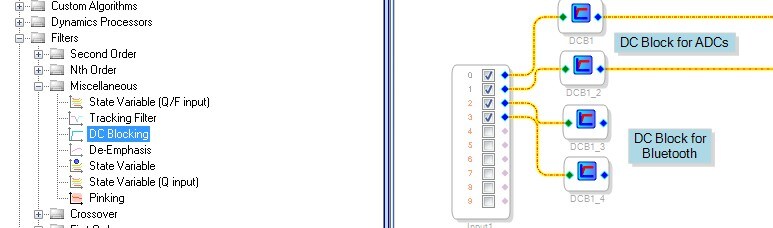
Insert a DC block in the Bluetooth audio path right at the input to the DSP. Note, that it is also a good idea to do this on the ADC audio path since there is always a slight DC offset on the ADC output. If you then boost the low frequencies using a shelving EQ then it will amplify this DC level and make it even worse.
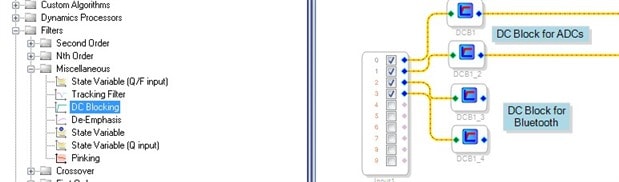
Here is a screenshot showing what I suggest to do and where the cell is located in the tree toolbox:
Method 2:
Is there any way to get a GPIO signal from the Bluetooth module that will only be active when the audio is being sent and then switch to another signal when it is not being sent? Then we can tie that GPIO signal to a switch in the DSP to switch to and from the Bluetooth input only when there is a signal?
If this is possible then I will send over a project as an example.
Dave T
Please log in to reply.