Where is the Full-Range RMS Compressor?
I'm running Sigma Studio 3.13, Build 4 under Windows 10, and am in the menu tree for the ADAU1451. Under Dynamics Processors / RMS / Full Range (-140dB to +40dB) / No Ext Detector Input / 1(or 2)-Channel/RMS (no gain), I open Show Graph and see a part that only goes from -135dB to +20dB, like the 'Lower Range' parts. The corresponding Peak Limiter block goes all the way, but these don't. What am I missing?
Audio Signal Processors
adau1451
SigmaDSP Audio Processors
Hello James,
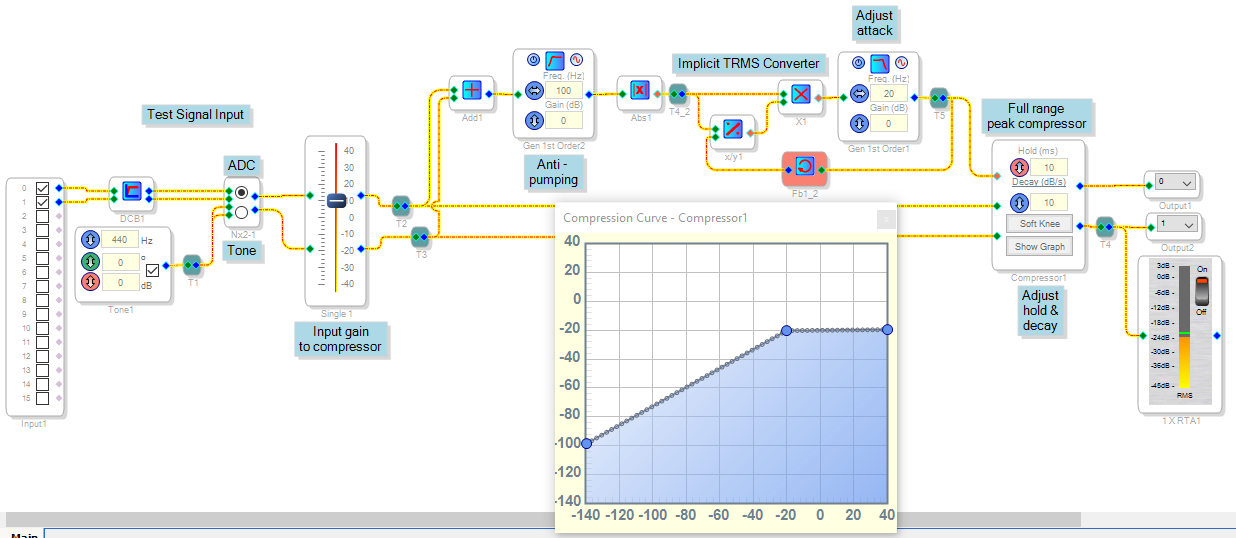
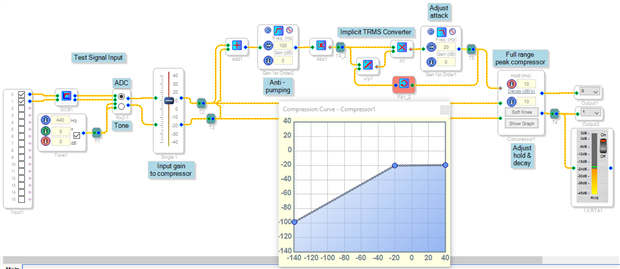
It looks like you're not missing anything; I see the same thing. You could try the workaround below. It uses the Peak Compressor with its full range, but feeds its external sense input with a homemade RMS converter to provide the desired response. If you've seen my other posts with this converter, you know it was shamelessly lifted from an old AD analog circuit. Its implicit technique is quite fascinating.
Adjust the lowpass filter in the RMS converter to set your attack rate; adjust the Hold and Decay times in the compressor as usual.
Best regards,
Bob
Hello James,
For stereo limiting you want to reduce the gain equally on both channels to keep the enter image from shifting. So having separate detectors for each channel would be bad. So then it comes down to how to handle the two signals in the sidechain.
One approach is to process them separately each with their own RMS detector then either adding up or simply taking the highest one to control the gain. The bad thing with this method is that there are two controls for the attack/release. etc., so it is up to the user to set these the same to have it react the same to signals from either channel. Some people would like this flexibility.
The other approach is to add the two audio signals before the RMS detector. Then only have one detector and one set of controls. So there is no way to treat the channels differently. Many high quality stereo compressors are designed this way. I designed an analog stereo compressor a few years back that summed the signals before the sidechain then sent the same signal to both sidechains. There were two sets of controls to allow for stereo operation and dual mono. This is sort of a third hybrid of the first two methods I mentioned above.
Then the other great feature to have for a compressor that handles full program material is to have a HPF in the beginning of the sidechain. This brings up the punch of the low end in a mix but also keep the high level of low end from reducing the gain of the higher frequencies. So the vocals or guitars will not duck when there is a loud bass note. So Bob has this all dialed in to his design. ( he must have lifted ideas from my analog design! ) (Just kidding Bob!)
So back to your question about why the graph is not different? I do not have the answer. Instead of guessing I will ask the programming team.
Thanks,
Dave T
Jim,
Yes, you might want separate rectifiers, especially for broadcasting since the circuit as shown essentially ignores what next becomes the FM subcarrier.
Dave,
Thanks for your input, with the wisdom of experience.
Bob
Hi, Bob, and thanks for that. One comment on the circuit, which indeed does look like a thoughtful workaround: Doesn't adding the two channels before rectification mess with the stereo image some? Wouldn't one purposely-lo-level channel cause the other to increase? Generally in stereo processing, for broadcast anyway, the rectifier is duplicated and the max from the pair does the gain control. I'm intrigued by the 'anti-pumping' high-pass; doesn't that allow deep bass to exceed the r.m.s. limit at the output?
Hi, Dave,
In broadcast audio processing, as opposed to audio processing for studio recording, our firm was drawn, kicking and screaming, into the realm of 'maximum loudness' and consistent modulation peaks at 100% (and very little modulation below that sacred figure). That was more than 40 years ago, and it's still with us.
Your suggestion of separate rectifiers for the two stereo channels and, actually, taking the higher of the two as a reference for gain reduction, is SOP in our domain. With typical program material, which nowadays is synthetically-generated stereo (pan pots 'n' stuff), energy levels between channels is generally fairly consistent, especially at low frequencies and with solo vocalists, both of which are typically 'mono'd' in the studio. Nevertheless, some music has substantial energy variation between channels, and if I were a fan of pop music I could probably cite album and title. In those cases, summing the channels before rectification could cause the limited/compressed active channel to increase by as much as 6dB should the other channel go dead. This is, of course, a worst-case scenario, but illustrates the situation. Independent L/R rectification and taking the higher control signal of either channel, would hold the level of the active channel (and the stereo image) constant.
Years ago, our firm marketed a quite complex 'airchain' processor (the one just before the transmitter) that had separate rectification of L and R, but did not take the higher of the two channels as a gain-reduction reference. Rather L and R were processed independently. The effect was that perceived loudness was a tiny bit higher (and broadcasters want every fraction of a dB they can get!), but the stereo image went to hell in the proverbial handbasket. Both L and R were peaking at max, despite the fact that the guitar on the left was much louder than the saxophone on the right (bogus example, but...). We were taken to task over this, not by loudness-hungry US broadcasters, but by quality-conscious Europeans. Imagine what this did to classical music and poetry-reading duets!
On a lark, I have run left and right program channels into the Sigma 'absmax' block, and hooked its output into an r.m.s detector to control both channels. It didn't quite work, of course, because the maximum value of the two full-wave-rectified program channels had a very strange waveshape, which the r.m.s. detector had no idea what to do with. So you are right, of course, one would have to use two r.m.s. detectors, "OR" their outputs, and then make sure that the detector time constants were set the same.
Jim
Hello Jim & Dave,
For an "airchain" processor, I'm wondering if OR-ing the levels of (L+R) and (L- R) for gain regulation would make sense, since this is what the transmitter ultimately works with.
Best regards,
Bob
Bob,
There is one broadcast audio processor of note that performs most of its its gain control in the matrixed, L+R and L-R domains. At the tail end is a de-matrix that puts the audio back to L and R, as the FM stereo-generator is set up for L and R inputs. The processor I'm thinking of had an early following among broadcasters, but it does impart a character to the 'spatiality' of the program that Program Directors either like or don't. I am fairly certain that ORing of control signals was variable in that product, allowing one to increase the lower-level L-R component to broaden the stereo soundstage. One negative to that, however, is that increasing the stereo difference does exacerbate the audible effects of FM multipath distortion somewhat. More contemporary processors with 'stereo widening' capabilities work on a dynamic basis, generally increasing the L-R component under transient conditions or when program levels are high enough to help mask multipath effects.
Jim
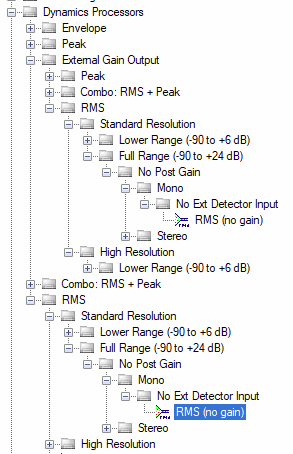
In the Tree Toolbox, there are two entries for "full range" RMS (no gain), No Ext Detector Input, Mono. One with external gain output and one without.
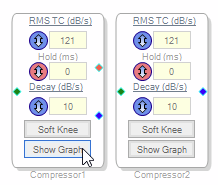
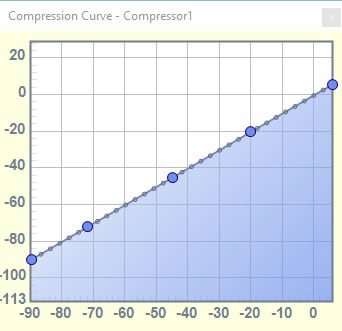
But when I click "Show Graph" on either of these
it only goes up to +6 dB instead of +24 dB
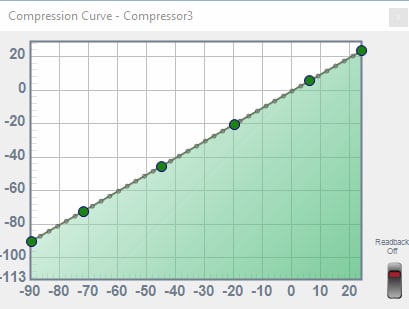
The peak "Full range" goes up to +24 dB:
Hello J3627,
If you use one of the compressors or limiters with an external detector input then you can customize the range externally.
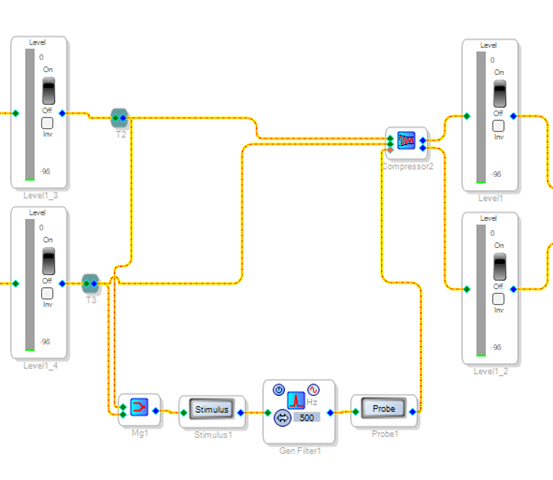
Here is an example where I filtered the sidechain signal:
If you use the signal merger it will reduce the sum by 6dB. It you just add the two channels then it will add 6dB and then you can put in a volume control and boost it up even more. So if you boost the sidechain signal by 15dB then the top of the graph would be +21dB. It increases the sensitivity to incoming signals. In my axample with a filter you can make a de-esser or something like that.
So put in a volume control on the sidechain input and you can make it be a higher range compressor.
Dave T
Please log in to reply.