ADAU1452 FIR maximum filter size
I am evaluating the ADAU1452 SigmaDSP on the EVAL-ADAU1452MINIZ EVM board. In the user manual it states that the ADAU1452 can perform 24,000 filter taps per sample at a sample rate of 48kHz. In the SigmaStudio software, under the help topic "FIR", it states that the maximum number of coefficients in a FIR filter implementation is 800. I would like to experiment with a 2048-tap FIR filter. Will I be able to implement a 2048-tap filter with SigmaStudio on this EVM? When I import the 2048 coefficients into the FIR filter block the software seemed to accept them, but I am not sure they are being used.
Audio Signal Processors
adau1452
sigmastudio
SigmaDSP Audio Processors
evaluationboard
SigmaDSP
Show More
Hi DMR,
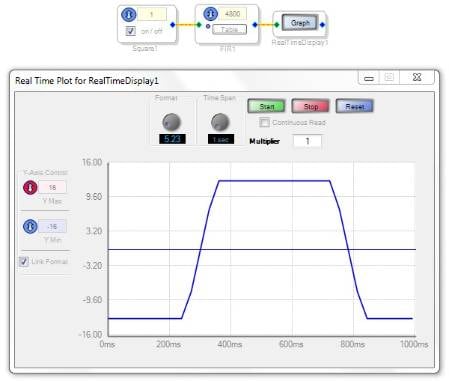
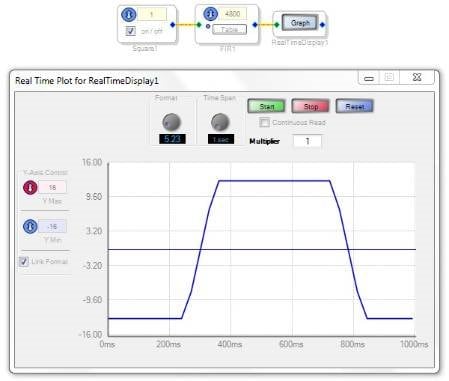
The ADAU1452 is rather new, so much of its related documentation is still trying to catch up. Thus sometimes the best way to see if something works is to just go ahead and try a test having a known result. I tested a 4800 tap FIR filter whose table contains +1.00 in each 48th position, and zero everywhere else. This acts as a crude lowpass filter. If we put a slow square wave in, we can measure the length of the filter's impulse response during each input transition. We would expect the filter to stretch the square wave's rise and fall times to a full 4800/48000 = 0.1 second, if it's really using the entire table.
The Real-Time Display shows the expected result, so I conclude that you'll have no trouble running a 2048 tap filter.
Best regards,
Bob
Bob,
Thank you for the prompt reply. That is good news. I am now planning to use the SPDIF I/O on the EVM to send it an impulse and record the digital output to a .wav file. I can then input the .wav file into matlab and directly compare the impulse response with the filter coefficients that I derived in matlab.
Regards,
Dan
This question has been assumed as answered either offline via email or with a multi-part answer. This question has now been closed out. If you have an inquiry related to this topic please post a new question in the applicable product forum.
Thank you,
EZ Admin
Please log in to reply.