DSP evaluation board for audio amplitude modulation with 40kHz carrier?
Hi,
i'm a student and need some advice in choosing the right and affordable dsp evaluation board.
For a project i need to do some amplitude modulation with an audio signal (music) and a 40-45 kHz carrier.
This signal needs to be amplified afterwards to be send on a ultrasonic transmitter grid.
Now i'm afraid to choose the wrong evaluation board and the audio outputs and DACs can't handle the 45 kHz...
Do you know an affordable evaluation board that can manage this?
I have found the ADAU1761 Evaluation Board http://www.analog.com/static/imported-files/eval_boards/EVAL-ADAU1761Z.pdf
with the AD1938 http://www.analog.com/static/imported-files/data_sheets/AD1938.pdf which is capable of a sample frequency of 192 kHz.
Does this mean that i can get up to about 87 kHz (Nyquist-Shannon 192/2,2 = 87) on the output?
I'd be very grateful for any help or advice.
Thank you in advance
Christoph
Nachricht wurde geändert durch: Christoph Friebel
Audio Signal Processors
dsp
ad1938
amplitude_modulation
Integrated/Special Purpose A/D Converters
sigma
SigmaDSP Audio Processors
am
adau1761
Audio CODECs
dac
Show More
Hi Christoph,
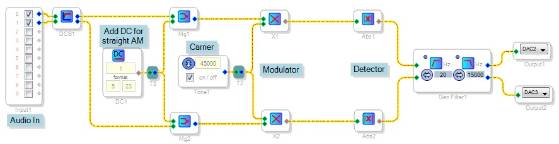
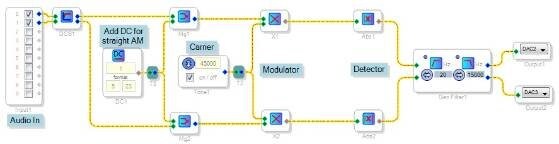
The Eval-ADAU1701MINZ board is often a good low-cost choice. Several folks on this forum have used it at ultrasonic frequency. The ADAU1701 can run a signal flow of up to 256 instructions (minus a few for housekeeping functions) at 192KHz. This limit has been problematic for some users, yet there's still enough room for some neat stuff. For example, the signal flow below
uses 107 instructions and easily fits. This modulates stereo audio onto identical 45KHz carriers, using straight amplitude modulation (DSB+C). Then it turns around and envelope demodulates the RF signals, sending baseband audio to the eval board's headphone jack.
The ADAU1701 has two analog inputs (ADCs), and four analog output DACs. When outputting RF at the DACs, you'll need to modify the eval board's output filters to allow this higher frequency output -- reducing the value of a few capacitors should do it. Since you're looking at the AD1938 codec (with eight DACs) and the -1761 eval board, perhaps your other requirements prevent use of the -1701 -- you'll need to consider that in light of your application.
Best regards,
Bob
Hello again,
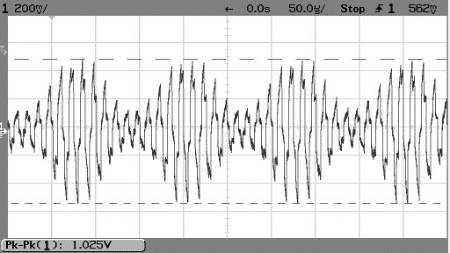
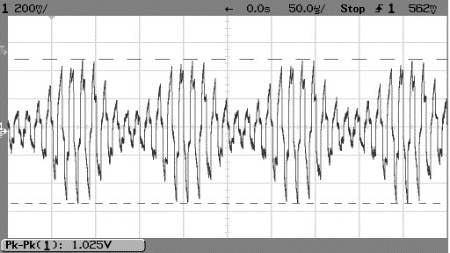
This photo shows RF (80KHz carrier, 8KHz 70% modulation) out from a ADAU1701's DAC. Not wanting to modify my eval board, I took the output right after the board's DC blocking cap without lowpass filtering:
Bob
Great! Thanks for sharing, Bob!
Christoph, if you need help changing the sample rate of your system, please follow this tutorial: https://ez.analog.com/docs/DOC-1431
Also, be aware that changing the sample rate will also restrict the number of instructions you can execute in your program, as described in this FAQ: https://ez.analog.com/docs/DOC-2734
Hey Guys,
thank you so much for helping me! I posted in different forums and nobody could help me. I was nearly giving up on this and was about to think about a workaround where i would do the amplitude modulation in the analog domain. So you both just made my day.
So if i understood you correct, Bob, it's possible to pickup the signal right after the DAC. How did you do this exactly? I'm afraid i'm not confident enough to change the capacitors directly on the board. My soldering skills are not very good ;-). So when picking up the signal right after the DAC, it should be possible to build a new analog lowpass-filter with a higher cutoff frequency on a breadboard, right?
Thank you again
Regards
Christoph
Hi Christoph,
Thanks for your kind reply!
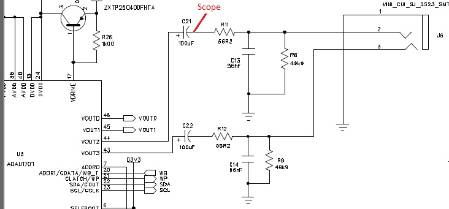
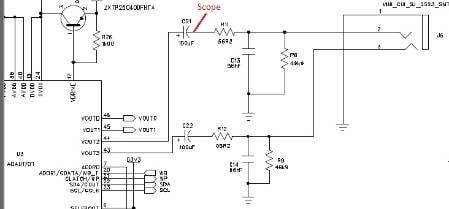
I picked up the modulated RF from the eval board simply by touching a probe tip to the point shown below:
C21 and C22 are quite large, so you could easily solder a fine wire to each in order to pick-off the unfiltered outputs there. That way your eval board remains otherwise unmodified -- you could easily remove the wires later.
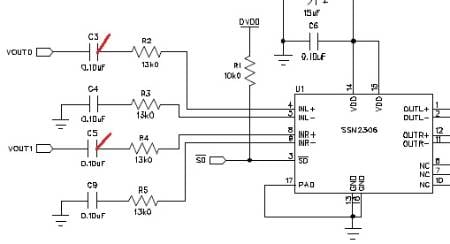
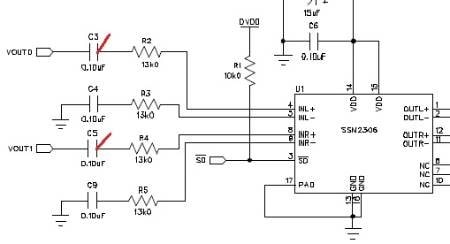
If you also need the other two DACs, you can snag their outputs the same way:
I didn't even bother to filter the DAC output for the scope display, however likely you'll need a more proper output. You could use passive or active filters as desired. Analog Devices has an online active filter design wizard available here: http://www.analog.com/designtools/en/filterwizard/#/type
Bob
Hey Bob,
that's really nice of you. I can't thank you enough.
I've just one last question...
Is it true that Sigma DSP can't be programmed in C and therefore have to be programmed with the Sigma Studio tool?
If i would be forced to do the project in a higher programming language without the help of a graphical tool like Sigma DSP i would have to buy a SHARC Eval Board like the SHARC 21469 EZ-KIT LITE, right?
This will be an expensive project then... ;-) Especially if it takes longer than 90 days and one needs to buy a licence for the VisualDSP++ IDE.
Thank you and regards
Christoph
Funkandsoda wrote:
Is it true that Sigma DSP can't be programmed in C and therefore have to be programmed with the Sigma Studio tool?
True. Please see this FAQ for more details: https://ez.analog.com/docs/DOC-1425
Funkandsoda wrote:
If i would be forced to do the project in a higher programming language without the help of a graphical tool like Sigma DSP i would have to buy a SHARC Eval Board like the SHARC 21469 EZ-KIT LITE, right?
This will be an expensive project then... ;-) Especially if it takes longer than 90 days and one needs to buy a licence for the VisualDSP++ IDE.
Yes, you would have to get a Sharc if you want to program using higher-level languages, since SigmaDSP doesn't have a C compiler.
As a side note, some Sharcs now are supported by a special version of SigmaStudio: https://www.analog.com/en/dsp-software/sh_sigst_00/sw.html
Brett, thanks for responding with your explanation & link.
Christoph, As Brett noted, you can't program your SigmaDSP in C. If your finished system is to be self-contained, you'll eventually need an external microcontroller to load your SigmaDSP with the object code that SigmaStudio generates -- and you'll program that in C or assembler. Perhaps the effort this takes will satisfy your course requirements. Some SigmaDSPs can alternatively self-boot from an external EEPROM, while none have built-in flash ROM.
Bob
Thank you both very much! This helped me a lot.
Please log in to reply.