SigmaDSP Part Selection
Hi all,
I don't have much experience with digital audio, I am more of a digital control systems guy. However, I had an idea for a project recently that would really help me out. It's essentially a small, specialized audio mixer. I tried designing a digitally controlled analog mixer, but the results were less than satisfactory. Doing a bit more research I discovered SigmaDSP, and what might be a rather unique and flexible solution to my problem.
At the moment, I'm not entirely sure which chip to focus on, which is holding me up from choosing an eval kit. With them being as expensive as they are ($700 each), I don't want to make a mistake and have to get a second one. My application calls for roughly 8 audio inputs, and 6 outputs. These will be used for distributing voice communications around, so this can safely be run at a lower sampling rate (48KHz will be more than enough). I had originally looked at the ADAU1701 as it had a few built in ADC/DAC, but now I'm starting to look towards the ADAU1446 as I will be able to sequester all analog signals to one part of my PCB. An added bonus is that my ultimate design will likely end up being rather close to what the eval kit is (minus all the bits I'm not using), which would make borrowing suggested component values a bit easier. I haven't looked into the specs just yet, but I think that one downside of going with the ADAU1446 is the increased clock speed, which will likely mean increased current consumption. This device will need to be battery powered ultimately, so I'm trying to keep consumption down to under 400-500mA.
Any thoughts on which might be a better choice?
As I mentioned, I don't have much experience in this area, so there are a ton of unknowns as I research. I have been playing in SigmaStudio, and even just changing inputs from I2S to TDM is a bit confusing. I am making progress, but please excuse any particularly dumb questions.
Thank you in advance for your help!
Audio Signal Processors
adau1446
SigmaDSP Audio Processors
evaluationboard
adau1701
Hi Joshua,
You may wish to look at the AD1940/41, which dissipates 240mW at 2.5VDC. Though it's an older-generation DSP running at 75MHz, it has enough instruction and delay RAM to support a good set of algorithm blocks (more than the -1701 for example). I have no experience with I2S or TDM data streams, so please check the data sheet to see if its digital IOs suit your application. You have two choices of eval boards for the AD1940, and they're cheaper than the one for the -144x at $200 -- 400.
Best regards,
Bob
Hi Bob,
Thank you for the reply. I had looked at the AD1940, but I was concerned about the 2.5V power requirement. I wasn't able to find a 2.5V ADC option on the Analog site, and if I can I'd like to keep all the chips in the same family.
I suppose another option might be the ADAU1761, which is a latest generation part, and runs on 3.3V.
I would love to find something similar to the ADAU1446 but in a smaller package, the 100 pins of the 1446 make it a lot harder to handle when designing the PCB and building it. No matter what way I go I will need some external ADC/DAC chips (or codecs), but 3 chips with medium pin counts will be easier to route over one massive chip and 2 medium ones.
Thank you!
Josh
Out of curiosity, in SigmaStudio, is there a way to copy a design and paste it into a new design?
I've done a schematic layout for the ADAU1446, which predictably doesn't use much of its resources (18% if I'm reading the output right). I'd love to try the same design on a few different chips to get a feel for their relative capabilities.
Is there a way to do that without redrawing the design each time?
Thanks!
Josh
Hi Josh,
With your first project already open, select "New Project" to open another project window. Drag the USBi and the chip you want to use into the Hardware Configuration window and connect them together as usual. Then return to your original project's schematic window and press Ctrl-A to select everything. Go back to the schematic window of your new project and press Ctrl-V to paste it in. You may need to massage your wires to make them neat again. Any blocks incompatible with the new project won't paste. Once you work around any such problems, you're ready to compile.
The AD1940's 2.5V requirement is a bit strange. However, you can download the user guide pdf for either of its eval boards to see how AD interfaced their own codecs.
Bob
Hi Bob,
Ah, perfect, I wasn't aware that SigmaStudio would let you have two projects open simultaneously. My copy/paste required quite a bit of touch up afterwards, but I was easily able to flip back and forth to make sure I was copying faithfully.
On the ADAU1701, my configuration used 643 of 1024 instructions. So I would have a bit of room to grow, which is alright by me.
It would be interesting if I could squeeze my application into an ADAU1701 and a PCM3168A codec from TI. It offers 6ADC, which, coupled with the 2 internal on the 1701 gives me what I'm looking for. The bummer here is that the 3168 requires 5V for its analog section, and I was trying to keep the design at 3.3V.
Interestingly, I did have a look at the AD1940's eval board, and it appears that Analog have just connected the two chips together through 100 Ohm resistors. No other level translation appears to be present, even on the control data port.
So, I'm still stuck trying to decide, but at least learning a lot about the different options in this family!
Thank you,
Josh
Hi Josh,
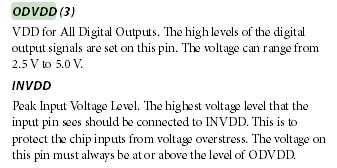
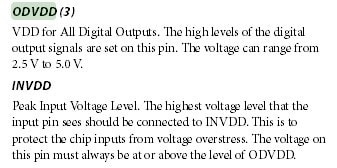
Actually, the VDD pin on the AD1940 is just the core supply. It needs to be 2.5 V. However, the input and output voltage levels are set by INVDD and OVDD, respectively. They can range anywhere from 2.5 V to 5 V. Here is the corresponding description in the datasheet:
So, you can easily set this to 3.3 V and then interface directly with whatever converter you want.
A good selection of codecs might be an AD1938 (4 ADCs, 8 DACs) and an AD1974 (4 ADCs), giving you a total of 8 ADCs, 8 DACs. The nice thing about the AD1938 and the AD1974 is that they have the exact same pinout, package, register map, et cetera... So you don't have to learn two separate devices. They're essentially the same, except for channel count and power consumption.
AD1938: http://www.analog.com/en/audiovideo-products/audio-codecs/ad1938/products/product.html
AD1974: http://www.analog.com/en/audiovideo-products/audio-ad-converters/ad1974/products/product.html
Hi Brett,
Ah, I reread the AD1940 datasheet and it becomes much clearer now! My only problem with that chip is that it doesn't have the option for self boot. I would like to add that capability to my PCB so that when I am first starting to use it, I can use self boot to verify that the DSP and all external ADC/DAC are working before trying to do a microcontroller based boot.
It's funny you mention the AD1938 and AD1974, late last night I had looked at them and decided I'd rather go that way over the TI chip. I like the idea of keeping all the chips in the same family, and the pin compatibility aspect is quite nice.
I think I need to start drawing some schematics and we'll see how it goes.
I am considering ordering the ADAU1710 eval board (EVAL-ADAU1701MINIZ), as eventually I'll need a USBi cable anyways. I do wish it came with an external codec like the full board, but the $500 price difference is rather significant. I think I can get the information I need off the user manuals.
Thank you!
Josh
Hi Josh,
Depending on my workload at the time, I would be happy to review schematics and register settings for your design that includes the AD1938 and AD1974. For a standalone ADC, please find the ADAU1977. A similar part, the ADAU1978, will be releasing soon. The ADAU1978 has very similar features and specs to the AD1974 in a smaller package with lower power consumption.
Best regards,
Coleman
Hi Coleman,
Thank you for the offer, I might take you up on that once I'm a bit further along. Is there a better way to reach you, or should I use this forum?
Until your post, I had planned on based my analog front ends on the ADAU144x eval boards.
Now, I'm starting to wonder if I've made the right choice. The ADAU1977 that you mentioned has roughly half the power consumption of the AD1974. I haven't found a DAC that has a similarly low power consumption, so at the moment I'd only really be able to swap out the AD1974 for an ADAU1977. I would still use the AD1938 codec.
I do like that the ADAU1977 is a direct connect ADC, which means I might be able to do away with a bunch of front end circuitry, further lowering power consumption. I would be using the 4 channels for 2 electret mics, 1 dynamic mic, and 1 mic that could be either (probably switchable). My biggest hesitation is that it's a lead free package. I have never reflowed one of those before, and I am concerned about how it would go. Quad flat packs are nice and easy, as when they do short during reflow, I can easily repair it using solder wick.
I can't seem to find any further information on the ADAU1978, do you know any more about when it's supposed to release?
Thank you for the help!
Josh
Well, after another couple of days of reading and thinking, I'm considering changing things up a bit. Based on my reading of the ADAU1977 datasheet, I think its inputs will be ideal for my two electret mic inputs, and two line inputs. The rest will go to an AD1938 as they'll need some op-amp work to get them into range anyway.
I'm finding the design of the analog front end the most challenging aspect of this project. I know board layout is going to be tricky, but for me digital makes a lot more sense. These op amp front ends are really throwing me for a loop.
Josh
Hi Josh,
We have 2 other ADC products that are approaching release. The ADAU1978 and the ADAU1979 are 2 V and 4 V RMS differential input ADCs that have identical footprints and similar pinouts to the ADAU1977, with specs that are comparable to the AD1938 ADCs. I see from your first post that you need an 8 ADC / 6 DAC solution, so the AD1938 or AD1939 would probably be your best solution. I see that you have posted a separate question about the analog filtering for the ADCs, I will respond to that next.
Regards,
Coleman
Hi Coleman,
Ah, interesting. Do you have any idea when the ADAU1978 and ADAU1979 are scheduled to release? Are preliminary datasheets available? The Analog website returns zero hits when those part numbers are searched for.
At the moment I'm considering using an ADAU1977 and an AD1938, though I've also considered two ADAU1977 and an AD1938 with its ADC section disabled. The specs say the AD1938 and AD1933 essentially draw the same power, so I might as well stick with the more capable chip and turn some of it off in the hopes of lowering consumption.
Now heading over to the Audio section to respond to your other post!
Thank you!
Josh
Message was edited by: Joshua Koffman - fixed part number mistake
Hi Josh,
I will continue this consultation in a private discussion.
Regards,
Coleman
This question has been assumed as answered either offline via email or with a multi-part answer. This question has now been closed out. If you have an inquiry related to this topic please post a new question in the applicable product forum.
Thank you,
EZ Admin
Please log in to reply.