Thoughts on a cheap, hobbyist USBi?
I've designed an amplifier card for a solar powered camping stereo, which uses an ADAU1701 SigmaDSP for filtering, active crossover, bass/loudness enhancement and other features. I'm releasing the card as an open source project, to match the 'open source' nature of the original camping stereo design, and I'd like to encourage people to mess with the SigmaDSP code on the card and improve it as much as they can.
The stereo in question is called the "Boominator". It's small, it's loud, it sounds great, and it runs on solar power.
http://www.diyaudio.com/forums/class-d/104402-boominator-another-stab-ultimate-party-machine.html
The design log for my SigmaDSP based card.
http://www.diyaudio.com/forums/class-d/190571-purpose-built-boominator-pcb-project.html
On the current card design, the SigmaDSP is booted by an Atmel AVR processor. Users can download SigmaStudio and make alterations to the SigmaDSP code, recompile the AVR software with new SigmaDSP code, and reprogram the AVR with an ISP programmer. But if people want to perform "live tweaking" of the design when they're listening to it, they need to use a USBi. Unfortunately the cost of a USBi ($250+) is prohibitive for basically any hobbyist.
So...
If I took the basic USBi hardware design, replaced the BGA FX2LP with a SSOP part, changed to PCB to 2 layers and eliminated the SPI interface, I figure I could build a "cheap USBi" for about 25 dollars in low quantity. Only matter is the software to run on the FX2LP - theoretically I could cross my fingers and copy the USBi's EEPROM contents onto the newly created card and it might work, but I can't afford a lawyer
So, is there any hope of getting official ADI blessing, and software, for a cheap USBi gadget?
Terms:
- The "cheap USBi" hardware design will be freely published and available, anyone can build them if they want (I hold no financial interest)
- ADI won't have to release any source code, protocol IP, etc - a binary EEPROM image is fine.
- ADI has zero responsibility for any issues with the "cheap USBi". Users understand that if they need a proper development tool for commercial development purposes, they should buy the real thing.
And why I believe Analog Devices should allow such a gadget:
- You'll make SigmaDSP parts more attractive to hobbyists. Free development tools and inexpensive, third party programming tools are why Atmel AVR basically dominates the hobby microcontroller market, I can't see why SigmaDSP can't start making similar inroads in the DIY audio community.
- Hobbyists with SigmaDSP experience can find themselves with day jobs implementing SigmaDSP parts in commercial designs.
- Very little work involved. If the stock USBi EEPROM image runs on the "cheap USBi", you won't actually have to do any work. If switching FX2LPs requires small changes and a recompile, it should be only a small amount of work.
Thanks for your consideration!
Audio Signal Processors
cheap
usbi
sigmastudio
SigmaDSP Audio Processors
SigmaDSP
adau1701
hobby
Show More
Hello gmarsh,
It's true that any design with an EEPROM can easily be copied, since EEPROMs do not generally have copy protection implemented. This is true in the case of the USBi as well. So, I think it would not be difficult for you to copy the binary from our EEPROM to your design, thereby creating your own USB interface to use with SigmaStudio.
However, we would be unable to provide any support for USB interface hardware that was created by our users. We can only provide support for the existing evaluation hardware that we have designed, and of course any SigmaDSP system prototypes that our customers have created.
So, in short, I don't really want you to copy the EEPROM binary to your own design, and I will not provide technical support for you if you do so, but there will not be any legal repercussions, since we do not explicitly prohibit that in our EULA.
That being said, I want to clearly state that SigmaStudio is absolutely not freeware or open source, and it cannot be distributed. You need to obtain it either by purchasing our evaluation hardware or by requesting a key via our email address, and you may not distribute it to the public. SigmaStudio may only be used by system designers, and may not be distributed to end customers using products containing SigmaDSP. In effect, we want to limit SigmaStudio distribution to people who have purchased evaluation hardware, although we do allow people to request it for evaluation as well.
The primary goal in mind when we decided to not distribute the firmware source code for the USBi was to make sure that our customers would not mass-produce USB interfaces and start shipping SigmaStudio with their product. That is still our goal.
However, we want to support our customers and make it easier to create a computer-based control interface for their products. Eventually, we want to create a plugin for SigmaStudio that will allow you to generate a standalone GUI for your end customers. It will have your name and logo on it (no mention of Analog Devices anywhere), and it will simply expose some controllable parameters to the end user of the system. It would, of course, be supported by you, not by ADI. Once that plugin has been created, we would then begin to openly distribute the binary for the USBi EEPROM to allow customers to integrate a USB control interface into their system.
Eventually, it would be nice if we could make a "cheap USBi" as well, to lower the cost of entry into SigmaDSP development. That's on our "wishlist" for now.
I will speak to our legal department to see if there's some way we could give you official "blessing" to copy the binary, but to also enforce that SigmaStudio is kept strictly as a system designer tool, and not distributed to the masses.
Thanks for the clarification!
About 5 minutes after posting the initial question, I realized that I should have asked for a reconsideration of the EULA to allow unsupported use of SigmaStudio for non-profit/hobby purposes, instead of asking for permission to clone a USBi.
That being said, I have a PCB on the way for the "USBi clone" which I'm going to privately attempt - neither a completed unit, or the design files, will ever be given to anyone else. I'll share the design files (also privately) if you wish. If the clone works, I plan to use it as my "cheap, don't care if it breaks" SigmaDSP emulator and keep the USBi in the eval kit box. If it doesn't work, oh well.
For my (public) camping stereo project, I'm intending to program the SigmaDSP such that much of the processing can be altered by reprogramming the board controller to feed the SigmaDSP different parameters. SigmaStudio, or a USBi, will never be required to do any of this.
However, there will always be the odd "hardware hacker" who will want to get their hands a little more dirty than that. It would be great to facilitate that without requiring them to spend $250 on an evaluation board.
I think he has a great idea.
For example, I run a small business in brazil (www.acousticlassaudio.com). I'm actually still struggling to survive at the same time that I must keep up with the new technology. I recently bought a SHARC evaluation board (599usd) which I was really happy to pay for, I think it is REALLY worth it given the complexity of the board. That was for my learning process, not commercial applications for it yet. In the other hand, I'm developing a new small project (with commercial interest), an automotive crossover, that I would like to use the Sigma DSP. Problem is that I really would NOT like to pay 250 usd for a simple USB - I2C interface. My money is short and I must count every penny for each project... It would be simply great if I could have a non-supported capped version of the USBi, simply because for me it is enough. Another very important thing is, here in brazil, customs taxes are OVER 100% for import items like that. So I pay > 500 USD for the USBi interface, that I'm sure will be useful for this particular project but I'm not sure if I will use it again any time soon. Imagine if I could make my own here... It would be great. Please support his idea, I sincerely believe it would facilitate many people running small business lives.
We have an intern who will be helping me out this summer. Perhaps this could be one of the tasks we put on the project list!
Great. I'm sure that the number of customers using Sigma DSP will greatly increase!
Nice. If you're planning on making changes to the USBi, I might throw in a request or two.
I've noticed that the USBi itself doesn't like having the target power disappear. If I have SigmaStudio open and I power cycle the +3.3V rail supplying the ADAU1701 in my project, SigmaStudio appears to act normally but won't actually do anything - even rebuilding/reloading doesn't bring the DSP back up. After about 30 seconds, SigmaStudio indicates a target communications error (can't remember exactly what it says off the top of my head).
To get everything working again, just restarting SigmaStudio won't do, I have to unplug the USBi from the computer, plug it back in again and then start up SigmaStudio again. I don't know if this is a hardware quirk with the USBi caused by the I2C lines or DSP reset line being pulled low by the lack of target power, or if something in the USBi firmware is getting hung up in a bad state.
I'm in the early stages of bringing this card up so I might have a few other critiques before I'm done...
Thanks gmarsh.
Please keep the feedback coming! This will help with our redesign.
By the way, we're experimenting currently with an XMOS USB microcontroller that would allow us to stream audio in real-time to and from the evaluation board. It would also do I2C/SPI communication, so it could potentially dethrone the USBi, which uses a Cypress USB microcontroller.
This is extremely nice and Digikey has XMOS parts readily available. I must say thanks for considering our suggestion! Just please don't forget to keep it simple and relatively cheap, avoiding things like choosing parts only available in BGA package etc... Cheers!
No further suggestions just yet. Haven't picked up SigmaStudio in a few days, I'm currently banging out Atmel AVR software to boot and control the SigmaDSP.
It turns out my cheap USBi clone is officially a failure. I used a CY7C68013A in a SSOP package, booting from a cloned USBi EEPROM. It spends about 5 seconds trying to enumerate before Windows pops up that a USB device malfunctioned. Oh well... this isn't a request for help, I'm posting this to tell people not to bother.
XMOS parts are really nice. The need for a separate USB PHY is a bit annoying, but being able to get 500 MIPS out of a TQFP-48 is awesome. The asynchronous USB audio examples they provide are pretty great too, I can see that coming in handy for the emulator/soundcard combo you're describing. All I'll ask is, don't blast it with every possible feature and create another $250 emulator
Any thoughts on why it failed? I've been considering a similar project, and it seems like this would work fine.
I'm using a CY7C68013 and the real USBi uses a CY7C68053. The latter is a superset of the former, and I'm assuming that the USBi software uses some feature of the '53 that's not present in the '13.
The Cypress part enumerates fine with a blank EEPROM, so there doesn't seem to be anything wrong with the chip's implementation. I've read out the EEPROM of both the USBi and my card on more than one occasion, and they match, so I'm doubting it's an issue with the implementation.
I'm not sure of the differences between the CY7C68013 and the CY7C68053, but I imagine that they are not 100% code compatible.
I created my own version of the "USBi" with the CY7C68013 using the schematics in AN-1006 as a guide and my knowledge of how the programmer works, and I had no problems what so ever! (Well I say that, but of COURSE it didn't work the first time!) My design integrates the programmer onto the same board as the SigmaDSP (no worries, there are no intentions of even letting the end users see what SigmaStudio even looks like, I had to integrate the programmer so I could do live tuning of the system while it was already in place, granted we could have just put a connector on the front of the unit for the USBi to connect to, but whats the fun in that???). The first time I started it up, the I2C led didn't come on. After some trouble shooting I realized that:
1) You can't have the USBi plugged into the DSP I2C bus on power up, otherwise it confuses the lil bugger and it will just lock up on you
2) Because I figured it probably wasn't going to work the first time, I put in jumpers that I could easily remove to disconnect it from the DSP I2C bus for troubleshooting, and it still didn't work. I finally realized that when I disconnected it from the bus I had also removed the pull-up resistors on the SCK and SCL lines (which were on the DSP side of the jumper), so after I soldered on a couple of pull-ups it worked!
Yea, I'll admit that I'm a bit of a "hardware enthusiast" and utilized a particular *open source* microcontroller development board to copy the USBi EEPROM and burn mine with the same image (though this was mainly just for troubleshooting, and my plans are to create our own custom software and code).
As for 1) above; my solution was to create an RC circuit which would allow the USBi to happily boot from its self-boot EEPROM, and 1 second later, the circuit would connect the I2C bus to the DSP I2C bus. With this circuit all I have to do is power it up and 1 second later its ready to go!
(This was part of my senior design project, hints the title block info)
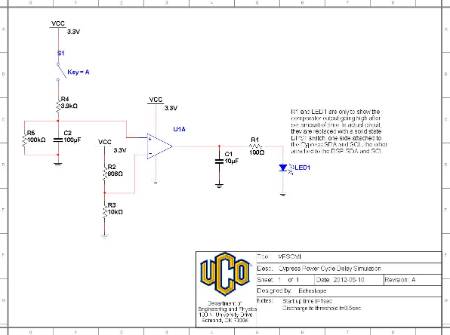
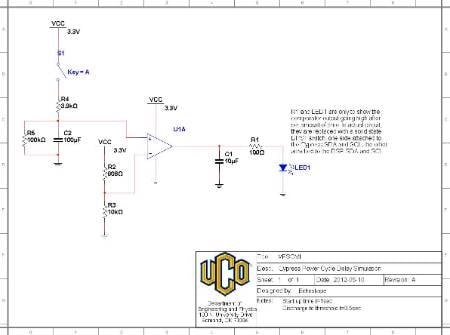
Interesting...
I'm using a PCA93xx (don't recall the part # offhand) I2C voltage level translator to separate the CY68013A and its configuration EEPROM from the target I2C bus - the enable signal is driven by the same signal which enables the analog switches on the 'real' USBi. I'm also using a 7404-like, open-drain picogate for the target reset signal. This allows an arbitrary target voltage without having to throw a 1.8/3.3V jumper. But I've hauled out the I2C translator thinking that it might be interfering with enumeration, didn't make a difference.
I'm using a 3.3V regulator with a power good output to drive the Cypress chip's reset pin.
To read the USBi EEPROM and write the EEPROM on my own card, I'm using a Bus Pirate. Maybe I've goofed something up in that process... I'll have to revisit this.
Ah yes, the Bus Pirate is an awesome tool. I used an arduino running a custom script I wrote that copies the contents from one EEPROM to another, identical, EEPROM. The other problem I had was I made the mistake of setting the address pins on the Cypress self-boot EEPROM wrong... which I don't think should matter since the chip is setup to search through the bus to find an EEPROM that starts with a particular value (don't recall it off hand), but I went ahead and made that change on my board before even powering it up since I knew it was wrong. Other than that, I didn't make any additional changes to the AN-1006 circuit, just left a few things off (didn't need all of the 1.8V stuff) and didn't put the 2 soildstate switches that are controlled by the PSoC (which after I made my soft start circuit, I went back to my USBi and plugged it into my ADAU1442 dev board and power it up, and it still froze even with its own on-board I2C bus line switches).
Poking and sniffing is fun, no doubt.
Sometimes you have to say: I don't like it, but here take $180 and give me that USBi.
Then develop something interesting, to see if you can make $18000 and then say:
I won, didn't I tell you so in the beginning.....
Thanks echoskope.
This is an interesting solution and maybe we can implement this kind of feature on the next board revision.
Hi there,
How is it going? I'm very glad to know that USBi clones were successfully made already.
Listen, I have two projects to develop with Sigma DSP. At this point I REALLY could use an USBi clone. Can these clone designs be shared along with the EEPROM image or is there any legal problems with that?
Please let me know ASAP.
Thanks and good luck!!!
Update: my USBi clone works!
I had accidentally installed 100K I2C pull-ups on the emulator instead of 10K - suffice to say, there were timing issues preventing the Cypress part from booting properly. Pull-ups are now 4.7K and everything looks fine on the scope, the card enumerates as a USBi, and I can read/adjust parameters on my camping stereo card through SigmaStudio.
I'll post the Eagle files later tonight, but I won't post the USBi EEPROM dump. I'll make the statement that the design is only intended for people to make a disposable clone of a USBi that they already own, for usage in scenarios where there's a high chance of frying the real emulator - designing something that runs off an automotive electrical system etc. It's the responsibility of the end user to read the EEPROM off the USBi that they own and program it into the clone themselves.
That's awesome! Reminds me of my PicKit 2 clone that I almost always integrate in my PIC development boards
Well, I just sent a PM to Brett to know if it's legal to obtain a copy of USBi EEPROM without buying one, let's see what he says.
By the way, usually I use 2k2 resistors on I2C busses, as I already had problems operating with 4k7 at higher speeds with more than one device connected.
Best of luck!
That is awesome that you got it working! I agree with you, it wouldn't feel right for me to post the EEPROM dump for everyone to use, especially if you don't have a development board, since the USBi is for use only with SigmaStudio...
Eagle files are attached for the "USBj", my USBi clone. Note that I'm using my own 6-pin header/pinout instead of the typical 10 pin USBi connector. No BOM/gerbers/etc are provided, you'll have to generate those yourself. And again, I'm not providing code for the microcontroller.
Hi everyone,
Sorry for the radio silence on this issue. I'm checking with our legal department about how I should proceed with this. I will respond once we have figured out the proper way to move forward.
Hi BrettG, thanks for the follow up.
I look forward to your answer, I have two projects to start developing with Sigma DSP.
Thank you!
Good to hear it's under consideration.
I'll reiterate my opinion that SigmaDSP parts have endless possibilities in the hands of electronic hobbyists - they're a unique set of parts that greatly simplify DSP for people who just want something to work.
One of my friends had the idea of making a DSP-based multi-effects guitar pedal for an engineering senior project. After bouncing a few ideas back and forth with him, and realizing he probably wasn't going to make any quick headway if I loaned him one of my Blackfin EZKITs, I pointed out the SigmaDSP family to him - I'd never used one before, but they seemed fairly decent. It only took a couple of months for him to get his hands on a '1701 evaluation board and get the system fully working with a microcontroller running a LCD, reading knobs and adjusting parameters in the '1701.
I can't think of any other chip/development environment on the market that would have allowed that to happen.
It's his positive experience with the SigmaDSP that led me to throw the '1701 in my camping stereo project - it's a ridiculously easy chip to get going, very flexible, decently powerful, just plain perfect for the application. I can see all sorts of other places, in the hands of audio DIYers, amateur radio enthusiasts and so forth, where SigmaDSP parts could also find themselves perfectly suited.
Having inexpensive development tools/hardware available, and an adjusted EULA for SigmaStudio that allows unsupported use by anyone, would kickstart a lot of that IMO.
Thanks again!
I agree 100%.
Hello
gmarsh, thank you for your investigation.
I have the exact same feeling about SigmaDSP and it is great to see an usbj for onboarding. I m gona integrate it.
just one problem, the files included in the zip file you posted cannot be read by eagle 5.6.0 .. which version are you using ? do you mind posting a pdf file with the schematic only ? !
thanks in advance and good luck for your business
Yep. You can download eagle 6 and run it as freeware to visualize it, that's what I did. Anyway, here it is:
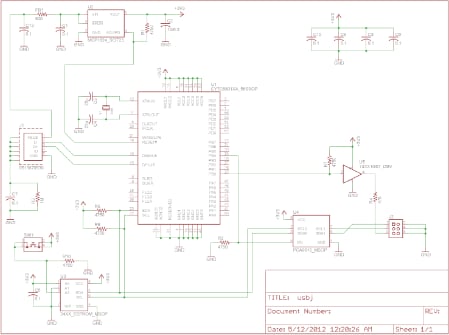
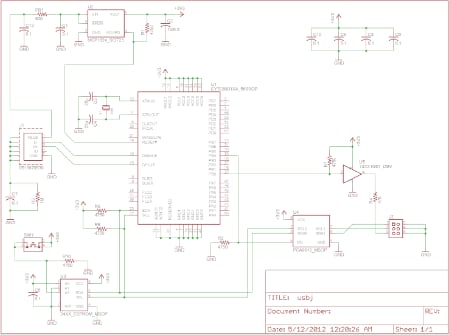
Thank you very much.
this is pretty straight forward in fact, but better to have it
Yeah, and I think he did a good job, schematic is very neat.
Hello,
on the same discussion topic, I can confirm that it is possible to use SigmaStudio with an alternative board containing a CY7C68013A like the one you can find on the "bay" with this description:
http://www.ebay.com/itm/EZ-USB-FX2LP-CY7C68013A-USB-Development-Core-Board-Logic-Analyzer-EEPROM-/220960809497?pt=LH_DefaultDomain_0&hash=item33724a6219 EZ-USB FX2LP CY7C68013A USB Development Core Board
Of course you need to create you own cable with 10 pin header and connect it to the board.
GND, 5V, SDA, SCL and RST from PB0 via a 475R resistor
Do not connect the boards to the usb yet.
do not connect the 10 pin header yet.
now, download and install the cypress SuiteUSB (got the 3.4.7).
Remove the jumper on the CY7C68013A board,so the EEPROM is on the adress A0 instead of A1.
Plug the usb cable and power the board.
Because the eprom is a 16bit eeprom, it will not be recognized by the CY7C68013A in A0
Then the board should be recognized by windows and enumerate in your device manager as
Cypress USB Generic Driver (3.4.7.0)
otherwise, just point to the CyUSB.inf file located in the Cypress installation folder.
Launch the CyConsole utility
use the Load button with the script ADI_USBi.spt located in the USB Driver folder of the SigmaStudio installation folder.
press the Play button.
The board will re-enumerate on the USB bus as
Analog Device USBi (Programmed)
Put the Jumper back in its position (this move the eprom back to adress A1 then it will not conflict with the one located on the ADAU board.
Now plug the 10pin connector to you evaluation board.
Launch SigmaStudio and verify that all is working
This is not a turnkey tuto with all screen shot that would be expected by a neewbee, but if you follow these steps one by one in this order with a freshly booteed computer, it works .
No need to duplicate the ADI eeprom with Buspirate or so.
Anyway I encourage to buy the original USBi board which makes life easier !
opensource and hacking is always a way to increase technology adoption by a larger comunity, right?
cheers
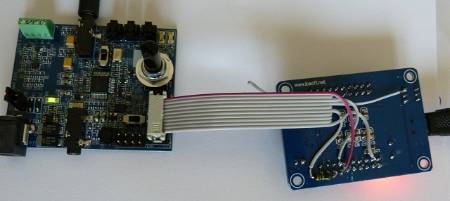
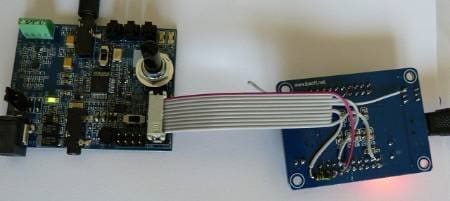
if it doesnt work in sigmastudio the first time, close it, come back in CyConsole and press the "reset device button" (yellow flash on the right in CyConsole) .
Close CyConsole and restart SigmaStudio.
That's a good post. This means that someone with a corrupted USBi EEPROM just has to lift an address pin on their EEPROM to change the chip address, and use the Cypress tools to reprogram it with the file you pointed to.
In fact the CyConsole load the script file (.spt) directly in the RAM memory on the uP chip, not in the eeprom..
To load in eeprom you need an .iic file, or the .hex file to be converted by hex2bix.exe ...
I havent find yet an easy solution to write the adi_usb.spt file into the eeprom.
Nevertheless, you are pointing a good direction : if you de-solder one pin of the usbi eeprom, then the device is recognized as a generic cypress, and then you can use it by downloading the .spt file. unfortunately it will not stay in the permanent eeprom and this is to be done at each power-on.
BUT there is a possibility to modify the cyusb.inf file to automatically download the .spt when the generic device is plugged in ... (this is known and documented by cypress as EZdownloader technic)
I ve tried but didnt have enough time to get something up and running... good luck if you try this route
Anyone want a bare "USBj" PCB? I've built two clones for my own purposes, and have 7 boards left over. They only cost me 50 cents each to make, I'll drop one in an envelope in exchange for a postcard.
You'll have to supply your own parts and EEPROM firmware. Secondly, I'll only mail a card to someone who can prove they already own a USBi - so take a picture of your USBi and a post-it with your nickname on it.
Hey, I'd like to have one or two... How much you want for the boards?
I just bought an ADAU1701 ez-kit with USBi. It will arrive september 1 as I live in Brazil and my friend is bringing it to me from Miami. I can take a picture no problem by then, just hold two boards for me please
Thanks!
Hi gmarsh,
Great job, well done! I realized long time ago that USBi is easy to clone just dumping the EEPROM. In fact I found it absolutely accidentally when once one of my USBi was defected Once, being not careful enough, I accidentally erased my USBi EEPROM content directly from SigmaStudio After contacting ADI for support and getting not really satisfying response I simple copied the EEPROM content from my buddy's USBi to my one and it work again I wrote about it creating a thread on EngineeringZone "SigmaStudio v3.2 and defected USBi interface" https://ez.analog.com/message/14971#14971
Since the time I was thinking about building my own USBi clone but never had a time to do that. Additionally I was never sure it will work with other, similar, Cypres µC with SSOP or QFN package. If you would still have some spare PCBs of your clone I would be grateful having one from you. I could try it using my EEPROM dump. My EEPROM is relatively old - I bought my first USBi around 2008/2009... Hier I would have question to ADI Team - BrettG, did you change/updated the USBi SW since 2008/2009? Would be any difference between my 2008/2009 USBi firmware and the newest one?
Cheers!
Tomasz
There was a small update made to the firmware in 2011 that would make the SPI lines go high-impedance when not in use, but I don't think that should have an effect on most systems because the USBi is the master and it's not a big deal if it is constantly driving those SPI lines. So, the older EEPROM images should be fine.
By the way, we're working hard to get a new update of the USBi out that will be much more stable. I also am very open to the idea of opening up the firmware for people to develop their own interfaces, but that's still in discussion here.
News?
Hi Brett,
any news from the legal department?
Thanks
I also wonder... It would be great to be able to make our own USBis.
BrettG wrote:
That being said, I want to clearly state that SigmaStudio is absolutely not freeware or open source, and it cannot be distributed. You need to obtain it either by purchasing our evaluation hardware or by requesting a key via our email address, and you may not distribute it to the public. ...
The primary goal in mind when we decided to not distribute the firmware source code for the USBi was to make sure that our customers would not mass-produce USB interfaces and start shipping SigmaStudio with their product. That is still our goal.
This is strange to me. Wouldn't making the software and USBi more freely available help to sell more chips?
I have a similar application in mind that would benefit greatly from open, or licensed USBi firmware. Is there any response to this from AD? (the thread shows 42 comments, however they are not visible, unfortunately)
JasonA419, not sure why you can't see the comments. Maybe you have an ad-block or NoScript that is preventing it from showing?
Looks like people have managed to get clones up and running. Open hardware designs have been posted in the comments, but due to legal reasons no EEPROM images have been posted. You would need to read the image from your own USBi, then load it onto a clone.
Last response from ADI was in 2012. They mentioned that they would look into doing a lower cost and open version, but they don't appear to have gotten very far.
PM me if you can't get the comments to work and I can send you the hardware design if you are interested.
This question has been assumed as answered either offline via email or with a multi-part answer. This question has now been closed out. If you have an inquiry related to this topic please post a new question in the applicable product forum.
Thank you,
EZ Admin
Please log in to reply.