adau144x TDM8 on scope
Hi , I am new to working with TDM8 24bits
I have adau144x working in master mode
The DSP is working in pulse mode in TDM8 24bit mode.
I have delayed by one set ( i2s mode )
So I calculate there should be 32 fs clocks per slot x 8 slots = 256 fs clocks for the whole frame between pulses.
It appears that I have maximum of 20bits of audio in the middle of the slots with 8 bits either side.
Also I have on the left what seams like strobing bits accross the 1st 24bits ( left to right ) with nothing in the last 8bits (right )
the sclk is 12.288mhz
FS is 48khz
The ADAU1446 is master on TDM8 bus.
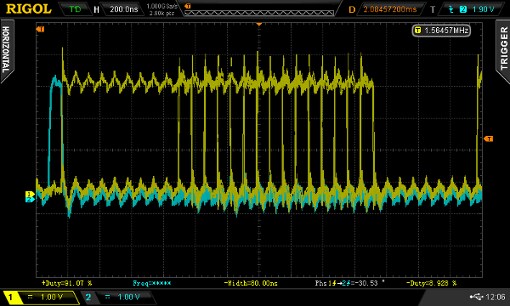
here's some pics from the scope.
the single slot,
My question really is , does anyone have a clue what could be causing the strobing across the 1st 24bits?
or is this normal for TDM8 ?
[EDIT]
I wasn't seeing the 1st 8 - 10 bits since I never got anything load enough out of the DSP. I set tone to 100% and the full dynamic range of the 24bits is used.
So that only the question about the line across the top of the bits on the scope. Is this expected ?
I tried unconnected my ARM proto board as its quite noisy and I still get the top line from the DSP.
Audio Signal Processors
24bit
adau1446
tdm8
SigmaDSP Audio Processors
polarity
Show More
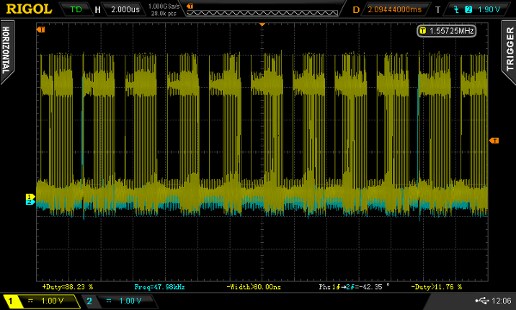

OK, unless anyone has any comments since everything is working in the recorder app in TDM8 I'll assume the top line ( trace ) is just normal.
Hello benybiles,
Sorry, I have been very busy recently...
Your single slot screenshot is very good. I can see that you have 24 bits of data and it is delayed by one BCLK cycle. There are 8 empty bits at the end so 32 bit slots. So it all looks good from that standpoint.
Now, I need some clarification, what do you mean by "strobing"? Do you mean the short spikes that are at the start of each bit? Are you talking about the sawtooth-like waveform across the entire waveform?
The spikes are overshoot and undershoot. The spikes are also on the bottom but are more difficult to see. This is caused by poor transmission lines and probably no dampening resistors or too high of a drive strength. It is important to tame these down. It does slightly stress the part but it also sends noise out onto the power and ground planes. The sawtooth noise comes from these spikes but it also can be a sign of too much resistance in the power and ground traces. When the clocks change it is a large current spike and if there is too much resistance, or an inductor, then it will drop voltage during that quick transition and then go away.
Proper bypass cap placement is also important to keep this noise down. Another byproduct is increased EMI radiation.
As I recall from earlier conversations on the forum, did you end up going to a 4-layer board or are you using a 2-layer board?
Dave T
Please log in to reply.